I look at the calendar with a kind of dread — this June it'll be 34 years since the moment I got the present I'd dreamed of as a twelve-year-old: a computer. Whether it was the computer I'd actually dreamed of, whether choosing an Atari 800XL was even the right call for me back then — that story is longer and more complicated than it sounds.
Even though I got a computer fairly early compared to my peers, if I actually count it out, I waited years for it. My dad — an electronics engineer, working at the time at the JVC service center on Chmielna Street (incidentally, Hackroom122 sits a few dozen meters from that same spot) — sometimes got electronics magazines through acquaintances who'd traveled to West Germany or further, to the UK. Somewhere in the early 1980s, in one of those magazines, I saw — oddly enough I still remember this — a color ad for the Sinclair ZX81, which, despite its astronomical price by Polish standards, was cheap next to other computers.
For a long time I thought that breakthrough magazine and ad had to be from 1982 or earlier — since that's the year the ZX Spectrum debuted, and the ZX81 was the earlier model — but while gathering various materials I ran into promotional material (including dealer guidelines) from a 1983 campaign offering a ZX81 bundle at a discount. That campaign ran through Christmas 1983, so I assume that even accounting for delay in someone handing me a magazine, it was at the very latest early 1984. It was definitely in color — and while the second image below (the Timex 1000, the American ZX81 clone) fits my memory a little better, I still can't say for sure which one I actually saw.
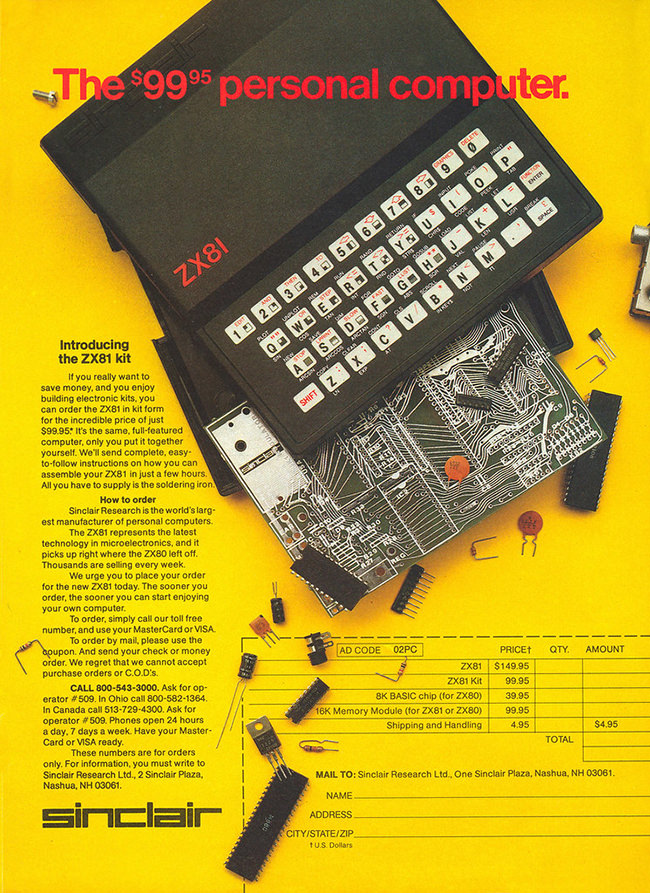
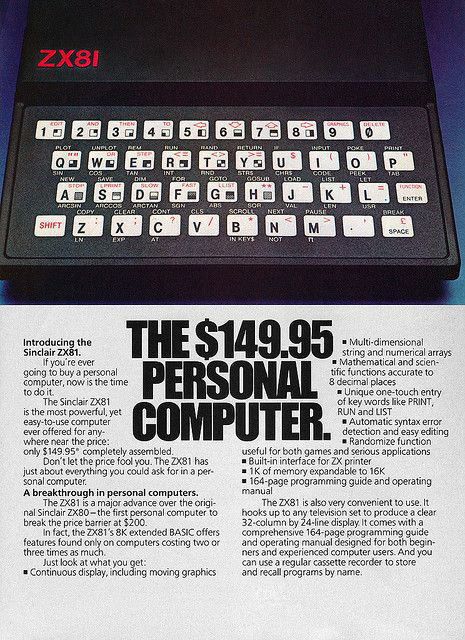
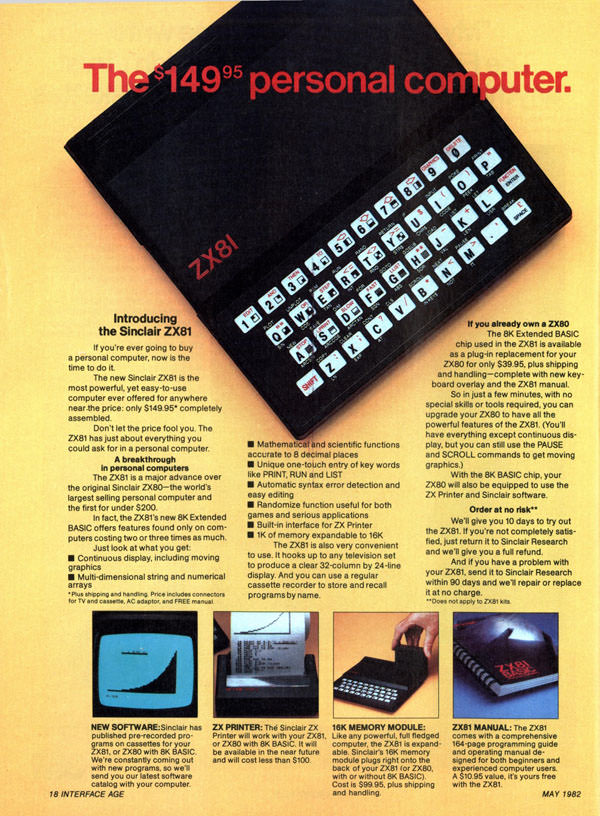
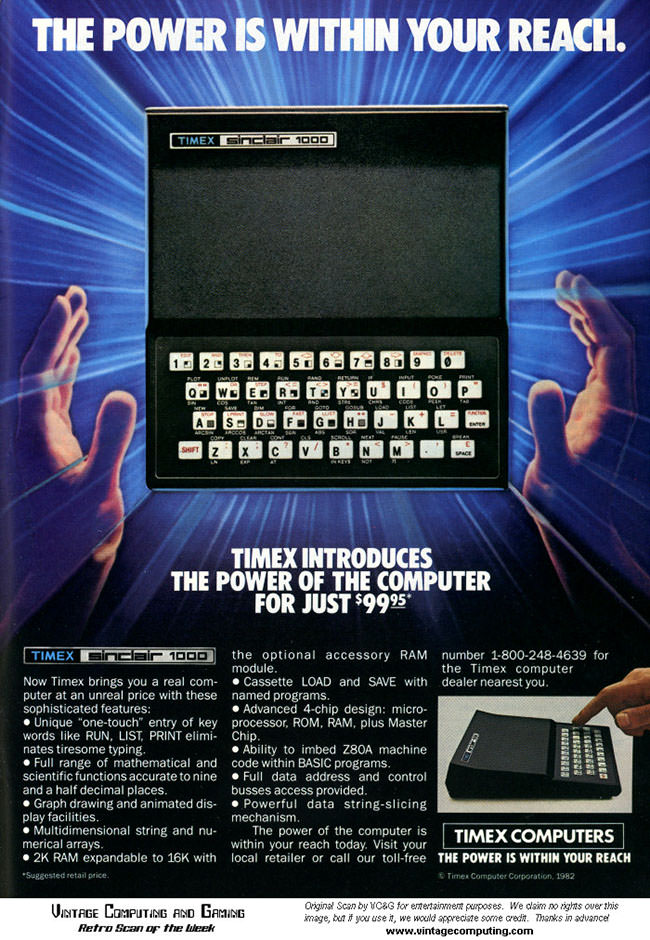
I remember being amazed — wow, a computer, and such a cheap one at that (it's enough to compare its £99 price to home computer prices of the era — a Commodore 64 cost around $600 at launch in 1982; the prices of everything else you'd actually seen or heard of, an Atari 400/800 or an Apple II, were astronomical by comparison). I still remember the conversation with my dad, and his simple argument: look, this is stripped down, this computer doesn't make sound or show color. With an engineer's typical way of arguing, dad killed the ZX81 dream. It was too basic a computer. But he didn't say no. He was, as he still puts it, part of the "calculator generation" — in his youth, wow, a calculator alone cost a month's salary or more. What came next — computers — was beyond anything he'd dreamed of as a kid.
I spent the time until June 1986 whining to my parents about how badly I wanted a computer, filling notebooks with pseudocode for BASIC games, and drawing shapes in grid notebooks and on graph paper. That must have been persistent enough that my parents and grandmother took pity on me. The decision to buy was made — but the choice on the market was pretty thin. I know my dad spent time trying to get more information — this had to be before Bajtek magazine even launched, and there's no sugarcoating it, there was a real drought of information about home computers. By 1985 there was already the Bajtek Fair on Grzybowska, which made reconnaissance a bit easier, except my dad wasn't sold on buying a computer — even a new one — secondhand, from a dealer. On top of that, some bigger family expenses landed right around then and the whole thing got pushed to "next year." I was crushed, but those weren't easy times, and there was a lot you had to just understand and accept.
Can you imagine that we didn't know a single person who owned a home computer? Today you buy a computer and you can ask friends, family, Facebook, the shop. Back then it was an abstract situation — fragmentary information about computers, about how reliable they were, what they could do. The Bajtek era was only just arriving — and what's more, the earliest issues of Bajtek barely helped with the choice at all 🙂 Monthly magazines dedicated to computers basically didn't exist — the odd mention in something like Młody Technik, or later in the still-young Bajtek supplement of Sztandar Młodych. In the States, the Atari 800XL was advertised by Alan Alda, known among other things from M.A.S.H.; here it landed for sale, like a ship from outer space, in the Pewex and Baltona store networks.
In June 1986, the Atari 800XL finally showed up at home. I was starting to lose hope I'd ever get a computer, but my parents — knowing my "obsession" — were probably also waiting for the right moment, and I got it right before summer break (a safe moment for my education). I think it was also a reward for placing first in a history olympiad (I only went to the first round because it got me out of class — and then somehow it just kept going, I liked reading and I liked history). I remember Atari was in serious short supply back then — shipments landed at Pewex in waves and vanished just as fast as furniture at the shop on Mazowiecka. On top of that, there was a bit of confusion — alongside the Atari 800XL my dad was considering, the Atari 130XE showed up too, a model that cost a lot more, too much for our budget. We decided to wait a week or two and hunt for the 800XL specifically.
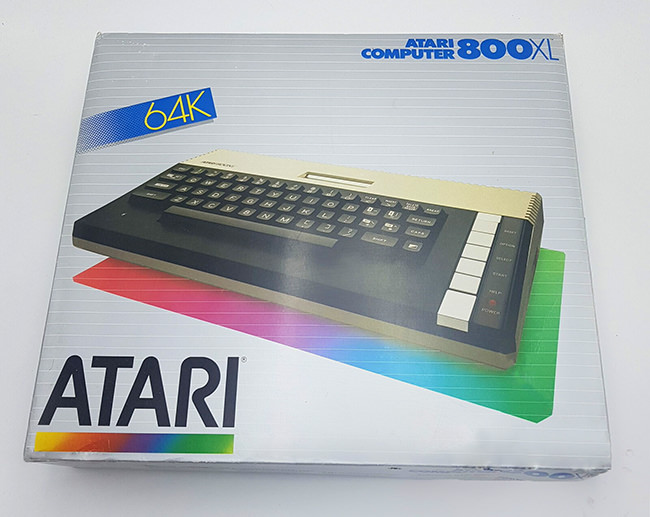
"Dad, but why Atari?"
"Because it has a warranty and service in Poland."
Hard to argue with that. Those were rational arguments, plus — it wasn't my money. 80,500 złoty came out to roughly $119 at some thieving exchange rate. I'd never seen that much money on a table before, it was a serious pile even just physically. That was something like three months of my mom's salary. I still don't know how my grandmother scraped together 50,000 złoty of it; my parents made up the rest.
At first we were aiming for what was probably the biggest (and first) Pewex, on Stawki Street in the Intraco building, but it turned out finding an Atari there in that period would have been a miracle. Then, I think, one of my dad's acquaintances called and tipped him off that there were Atari 800XLs at the Pewex on Świętojerska (today's Rossmann by the courts). We got in our Fiat 126p, made in Italy, and drove off for my first computer. If life has breakthrough, defining moments, that was probably one — the moment I got my first computer.
I'm not sure this is clear enough already — just the computer itself. No cassette deck. No joysticks. No disk drive (that cost $199 — almost twice as much as the computer itself!!!). For the first several days we hooked the computer up to the black-and-white TV we had at home. An impressive 26 inches of black and white, complete with ghosting and smearing 🙂
My parents very quickly realized they'd need to free up a different TV for me — first I took over the family's vacation TV, a UNITRA WZT TWM-315, and then I got my own personal set for my room: a Vela 202 TV that my dad modified — he bypassed the TV tuner circuitry and just gave me a "monitor" input — all because the computer sat running nonstop, since without a cassette deck I basically never turned it off.
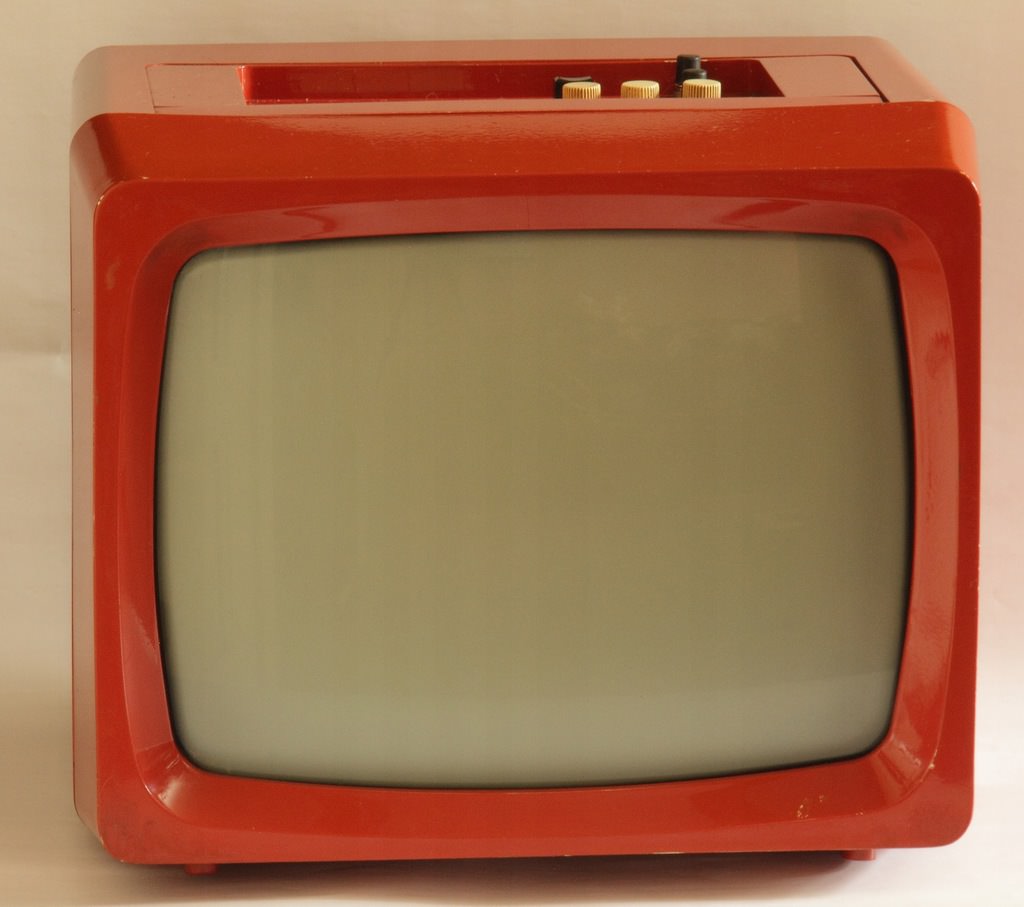
I spent the first weeks typing in program listings from wherever I could find them and getting furious about why nothing worked. A photocopied Atari BASIC book helped a little. It didn't work because I was typing "programs" written cold, in some ill-defined programming logic and BASIC dialect — I think it was a mix of whatever BASIC the ZX Spectrum got and BBC BASIC. That's when it hit me: I'd landed on planet Atari, and all the other computers were from completely different planets. That didn't stop me from hanging out at friends' places and playing on a ZX Spectrum or a VIC-20 — with one friend we even lent each other our machines — I'd borrow his ZX Spectrum and marvel at the sheer number of amazing games with titles every Atari owner could only dream about, and he, having a brother, was thrilled he no longer had to fight over the computer and could play alongside his brother at the same time. Honestly, if we'd just swapped computers back then, it would've been the optimal deal. Both sides would have gotten what they secretly wanted all along.
My parents took pity on me three times after that. First, my dad put together an interface to connect the Atari to an ordinary cassette recorder — I still remember the resin-cast SIO connector. I could finally load programs off the included cassette — I remember it was chess (CHESS) and another cassette with some simple BASIC programs — none of which impressed me much anymore, since after weeks of typing in everything I could find, that included cassette had nothing more exciting than Snake and other games I'd already "worked through." Unfortunately the East German cassette deck must have given up the ghost pretty quickly, and after the 1986 summer my parents took pity on me a second time — I got a genuine Atari XC12, the curse of every owner — but back then it was a dream come true. I could record and play back whatever I wanted.
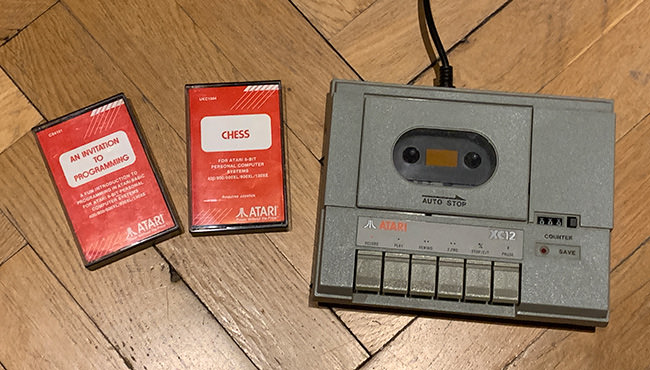
From September 1986 I was a regular at the Bajtek Fair, right up until it ended. I didn't trade there the way a lot of my peers did, but I showed up practically every two weeks to check what had turned up for Atari. Unfortunately the old joke "there's nothing for Atari" held true — most of the titles on Bajtek's top games lists were for the Commodore 64 and the ZX Spectrum, and only rarely was something available for Atari — which isn't to say there weren't good games, there were, and a fantastic adventure started for me, one that pulled me away for more than a few late evenings and nights.
My parents obviously didn't allow that kind of thing, but, teenager that I was, I found ways around it — I'd put a book over the function keys to hide the power LED glowing red, and I'd turn the monitor off by quietly pulling the plug from the outlet, since the spring-loaded switch might give me away.
The people behind the Loading channel tried to recreate the atmosphere of those computer fairs through interviews with people who used to go — though the period discussed in that video is a bit later than 1986.
The third topic is the joystick.* It wasn't cheap back then, and it was well outside our budget. And besides — I wanted one as soon as possible. My dad took pity on me and... built me one. I really regret not keeping it — I think it ended up in the trash when I switched to proper Quickshots, and it had a mastery of handling itself that suited those times perfectly. My dad built it out of the parking-brake lever from a Fiat 126p. The lever's rod went into a bearing mounted to one face of the enclosure, and its tilt was picked up by microswitches sitting "a floor below." In cross-section the base was an isosceles trapezoid, built out of pieces of aluminum angle stock and two pieces of wood. And here's the important part — it was the most legendary and most cursed joystick among my friends. Nobody wanted to play Decathlon against me with it, because everyone knew that if I had it, I'd win. The handle was heavy enough that all you had to do was hold the base and gently rock it, and the handle would "click" itself into place. I'd give a lot to get it back in my hands again. Things like that pick up sentimental value, unfortunately, usually only after you've already lost them.
So where's this Action!? Still on the horizon at this point. I had to wait for Action! until the "turbo" era. Unfortunately what I ended up with was some pirated copy transferred from disk to tape — a doubly reheated leftover. Not much of it worked, even though I tried hard to keep up with Wojtek Zientara's course. Incidentally — looking today at the materials that shipped with Action! and comparing them to what was published in the West, I have the strong impression that quite a lot of content got borrowed — but that was just how things were done back then.
My adventure with Action! was, unfortunately, short. Something didn't work. I had no reference books on hand, and just the course in Bajtek and Mój Atari wasn't enough for my appetite — back then, in the second half of the 1980s, Turbo BASIC XL won me over instead. It worked better, and I had it on a pirated cartridge along with a Turbo cassette loader.
And so, more than 30 years later, I sat back down in front of the screen, switched on Action!, and typed:
PROC welcome()
PrintE("Action! I'm back.")
RETURN

SHIFT-CTRL-M, C, [RETURN], R, [RETURN]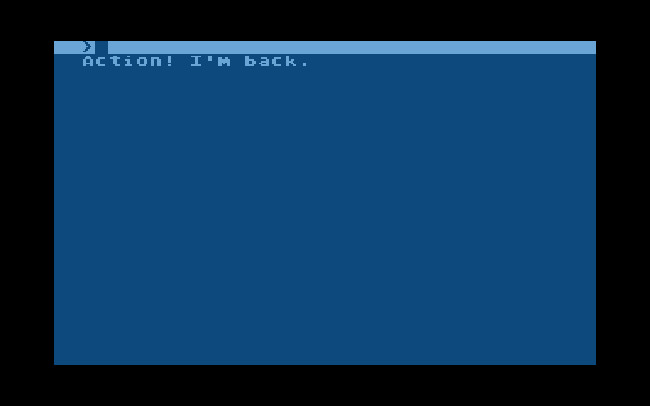
From here on, it only gets harder. And what happened to the Atari? In 1993 I traded it for a reverb unit — we needed one for our band's rehearsal space, and at 19, the band and making music/recording an album were the priority. What was that money worth? Back then, something like 250 złoty; today, for an Atari setup in a box, with the cartridge, the cassette deck, the tapes, the books, and so on, in the condition I sold it in, I'd probably pay four times that.
* the joystick story isn't over yet.