I don't know why we like generalizations. They're the enemy of precision, and they open the door to distortion, spin, and pointless arguments.
A while back a friend sent me a link to a video that supposedly proved "the Amiga is the fastest Macintosh." Wait, which Macintosh, which Amiga? Before I even watched it I spent a good while unpacking that sentence — and once I did watch it…
UNFORTUNATELY THE AUTHOR MANIPULATES THE MOST BASIC FACTS
He set out to compare an Amiga and a Macintosh from the same year — 1992, he says so at the start of the video. An Amiga 1200 (an 020 CPU @ 14MHz) against his chosen Macintosh, the LC III. That's already a suspicious setup at the outset: he picks the Amiga 1200 (Shapeshifter, the Mac emulator, won't run on the factory-weaker same-generation Amiga 600 from 1992, since it needs an 020 CPU — something you'd only get with a RAM expansion and a turbo card like the Furia), paired against one of the weakest Macintoshes ever made, stripped of its coprocessor. Sure, it has an 030 @ 25MHz and 32MB of RAM, but it also has a very slow drive on an already-slow (even then) SCSI bus — meanwhile the IDE drive in the Amiga flies. This comparison wouldn't even have been possible in the first place — you can't emulate a generation ahead of yourself on the CPU side, let alone the RAM. So what does the author do? He bolts on a Blizzard accelerator card with an 030 @ 50MHz, a coprocessor, and 32MB of RAM — a card from 1995. So where exactly is the "same-year computers" comparison? The first, simplest thing to notice: such a comparison would have been literally impossible in 1992 — the Blizzard didn't exist yet. The second, fairly amusing thing: even this basic homework wasn't done — the Macintosh LC III is a 1993 computer, not a 1992 one like the Amiga 1200. And unfortunately, from that same year, other Macintosh models are a lot more powerful. From 1993 you could pick a Quadra 605, effectively an LC 475. That machine, with an 040 @ 25MHz, already hits 22 MIPS — and could at least be reasonably compared to an Amiga 4000 with an 040 @ 25MHz, since that's effectively what it was.
THE HISTORY OF APPLE AND MOTOROLA'S 68K IS FAIRLY SIMPLE
Apple was probably the main customer for the 68k family of processors, given the sheer number and range of models it shipped. Unfortunately Motorola's struggles with delivering faster chips, and the overall trajectory of the 68k line, must have been deeply unsatisfying for a computer maker — because despite testing and prototyping computers with the Motorola 88k, Apple committed to a romance with PowerPC starting in 1992. That took a while to play out, since backward compatibility with software written for the 68k had to be solved, and the first PowerPC-based Macs didn't ship until early 1995. That's exactly the period when the Amiga's successors (Commodore went bankrupt in 1994) were stubbornly still betting on the 68k family.
THIS TEST WOULD HAVE ACTUALLY MEANT SOMETHING
if, for balance, the Macintosh LC III had also gotten a MicroMac Diimo/030 card (50MHz 68030, 64KB cache, with a 50MHz 68882 coprocessor). That would bring both machines closer to the same CPU/coprocessor/RAM baseline. On the expandability front, that same LC III could also take a Sonnet Presto Plus card (33MHz 68LC040 with an extra 32MB of RAM) — but a comparison built that way would carry about as much rigor as the video in question. Which is to say: not much.
AMIGA FANS, OVER THE MOON
— but what am I supposed to say? I love the Amiga, but this video is one of a billion pieces of nonsense you can find on the internet. Is a Motorola 030 @ 50MHz faster than an 030 @ 25MHz? Yes, I don't even need to power on a computer to know that. What's more — checking how many MIPS that Macintosh LC III pushes (6.3) versus the Blizzard in question (over 10 MIPS) takes less than the 13 minutes that video runs.
AN AMIGA WITH AN 060 PROCESSOR
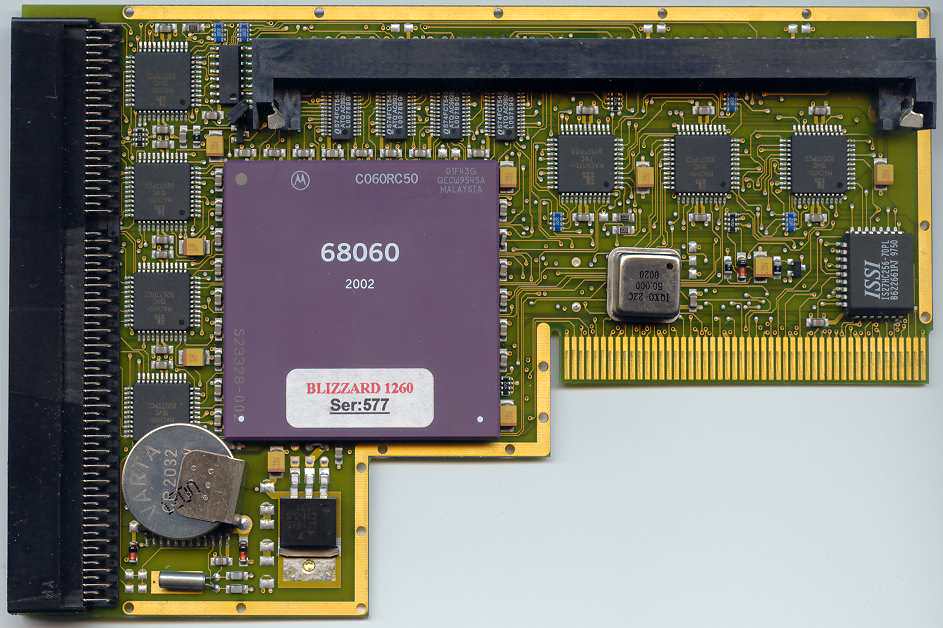
I'm not sure how to phrase this without upsetting die-hard fans of the 060 accelerator for the Amiga… In a race where there's only one runner at both the start and the finish line, that runner wins. Apple never offered a Motorola 060 in any Macintosh — because it jumped to PowerPC before the 060 had time to warm up in the Amiga's own lineup either — and by then, there was no more Amiga to speak of. An Amiga with an 060 emulates a Macintosh at a speed Apple never offered on 68k silicon at all — but PowerPC-based Macintoshes reach that speed easily. That's an entirely different story, though.
WHY EMULATING A MACINTOSH ON AN AMIGA CAN BE FASTER THAN THE REAL THING
To be clear: assuming we bring CPU/coprocessor performance to the same baseline on both sides (say, 030/50 or 040/25 — which is what actually shipped in the Amiga 4000), I think the Amiga can emulate a Macintosh more efficiently than the real hardware manages on its own. Why — or rather, what actually slows a real Macintosh down:
SYSTEM BOOT
In virtualization it's essentially instant. On real hardware you're waiting on two things: first, a memory test — the more RAM, the longer it takes. A plain restart is already the faster path. Second, the SCSI ID scan — real hardware scans the SCSI bus, reads every device and its ID, reads boot blocks, and so on. That takes several seconds — just launch HD SC Setup or Lido for a moment and you'll see that stepping through SCSI IDs 0 to 7 takes a measurable amount of time.
RAM SPEED
and access latency. RAM in the LC III is 100ns, running on a 25MHz bus; the Blizzard tested here had a bus running twice as fast.
DISK OPERATIONS
In theory PIO 0 tops out at 3.3MB/s; in practice you're looking at around 2.5MB/s — but these are modern cards, so that's close to the ceiling of what the Amiga's controller can push. That gets compared against a slow, old SCSI drive (40/80/120MB) — what actually shipped in the LC III. Drop a 2GB Quantum drive into that same LC III instead of the ancient factory unit and you could expect nearly a threefold jump in disk throughput. For this part of the test to mean anything, you'd need to put one of the oldest IDE drives you can find into the Amiga.
DISPLAY SPEED
The LC III draws its picture from VRAM — which in this model is both small and slow. Here, AGA and HAM8 mode on the Amiga is the faster path performance-wise, though I'm not sure the picture quality and the Macintosh LC III's output are even comparable — that unfortunate LC III draws 640×400px in 16-bit color as its base VRAM configuration (512KB), non-interlaced.
YOU CANNOT ACTUALLY COMPARE THESE TWO COMPUTERS' PERFORMANCE
— not in a way that holds up to the facts. There are Macintoshes faster than the LC III. There are expansion cards that make a Macintosh faster than an Amiga with an 060 @ 100MHz. Take a Quadra 840AV (040 @ 40MHz) — with just 2MB of VRAM it already outputs resolutions the Amiga can't touch: 1024×768, 1152×870 in 16-bit color — and fit that same Quadra with a DayStar PowerPro 601 (@ 100MHz) expansion card and it becomes a serious contender in any speed test. And funnily enough, I discovered today, completely by accident, that my Mystic (a Color Classic modded with a Performa 575 board, so an 040 @ 33MHz) can double its clock speed via the PDS slot thanks to an APMPU card (Apple Power Mac Processor Upgrade) carrying a PowerPC chip. Turns out even a dumb video like that can eventually teach you something worthwhile, if you're willing to dig for it 🙂
Edit: and just to stir the pot a little further — what if the fastest Amiga turns out to be a Macintosh… a Power Mac G5 Dual 2.5GHz running MorphOS?